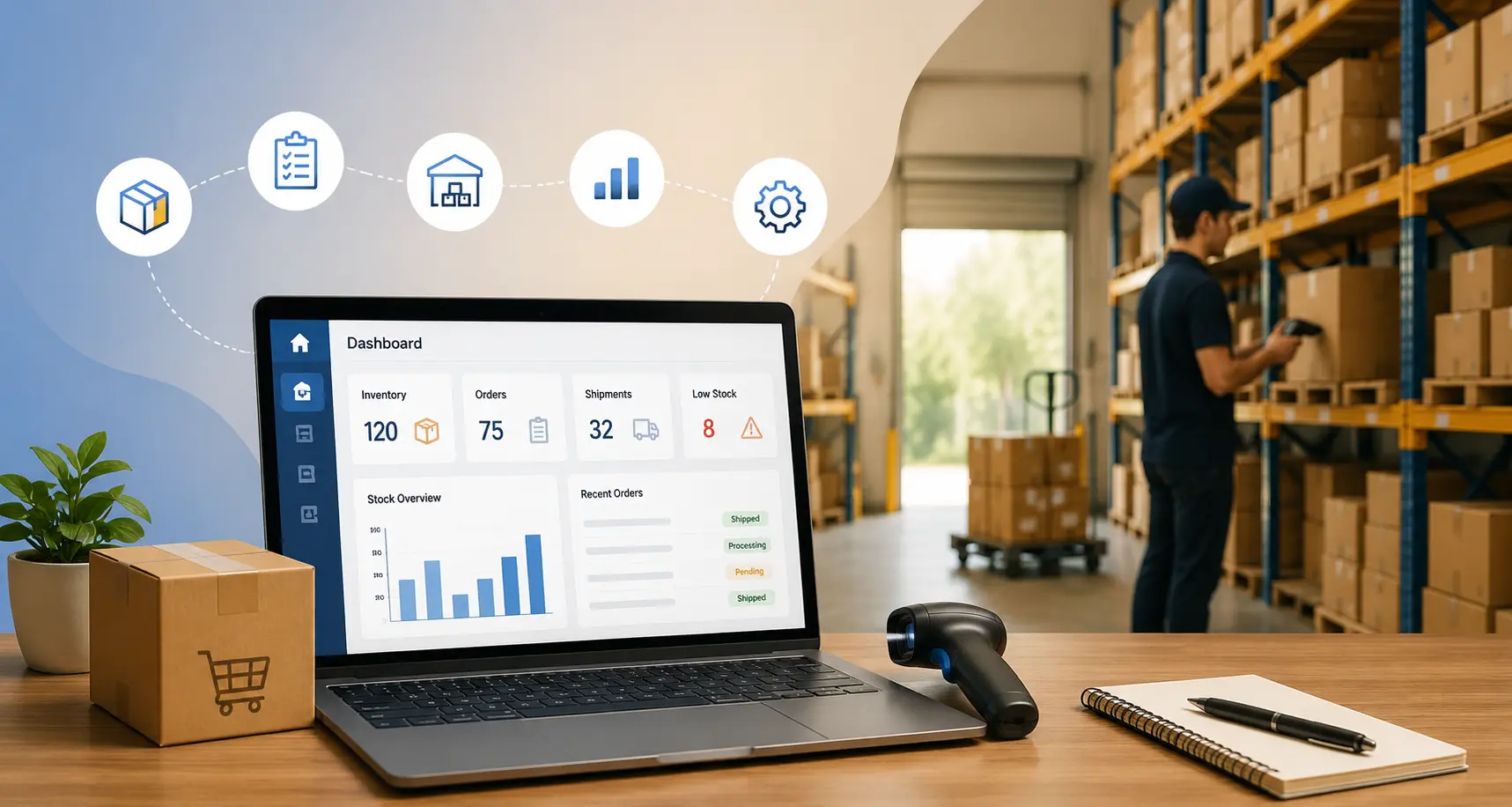
Here’s the problem with every ShipBob vs ShipHero vs Linnworks comparison you’ll find: they treat all three as if they’re competing in the same category. They’re not. You wouldn’t compare a taxi service, a car rental company, and a GPS app, even though all three get you from A to B. The comparison only makes sense once you understand what each one actually is.
ShipBob is a third-party logistics provider. You send them your inventory, they store it in their warehouses, they pick and pack and ship your orders. You don’t run a warehouse. You don’t need staff. You just need boxes and a Shopify store.
ShipHero is a warehouse management system. You run your own warehouse. ShipHero is the software that makes it work properly, telling your team what to pick, where it is, what to pack it in, and tracking everything in real time.
Linnworks sits somewhere different again. It’s primarily an inventory and order management platform, excellent at syncing stock levels and orders across multiple sales channels, but not a warehouse management tool in the operational sense.
Once you understand that, the comparison becomes much simpler. This guide breaks down who each platform actually serves, what it costs in practice, where each one falls short, and how to make the right call for your specific situation.
The Quick Answer
If you don’t want to run a warehouse at all, choose ShipBob. They handle everything — storage, picking, packing, shipping — from their own network of 60+ fulfilment centres.
If you already run your own warehouse and want software to optimise it, choose ShipHero. Their WMS starts at $1,995 per month and is purpose-built for ecommerce fulfilment operations.
If your primary problem is syncing inventory and orders across multiple sales channels like Shopify, Amazon, eBay, and others, Linnworks is built specifically for that. It’s not a warehouse management system in the operational sense; it’s a multi-channel operations platform.
If none of those descriptions match your situation clearly, keep reading. The reality for most growing ecommerce businesses is messier than a three-option choice, and the right answer often involves using two of these together rather than picking one.
ShipBob: What It Actually Is and Who It Suits
ShipBob is a 3PL (third-party logistics) company. You ship your products to their warehouses. They store them, pick and pack orders as they come in, and ship them to your customers. You access everything through their software dashboard, but the actual physical operation is entirely theirs.
Their network spans 60+ fulfilment centres across the US, UK, Canada, Australia, and Europe. For a DTC brand that wants to offer 2-day shipping to US customers without owning a warehouse, that geographic spread is genuinely valuable. Distributing inventory across multiple locations means orders ship from the nearest warehouse to the customer, which cuts both shipping time and cost.
The software side has improved significantly. Their WMS tools let you monitor inventory in real time, set reorder points, and view fulfilment analytics. ShipBob has also introduced a WMS product for brands that want to run their own warehouse using ShipBob’s technology, though this is separate from their 3PL service.
Where ShipBob works well
DTC brands doing 300 to 3,000+ orders per month who don’t want the operational complexity of running a warehouse. Brands with straightforward product catalogs: standard sized products, no hazmat, no extreme fragility. Companies expanding internationally who want warehouse presence in new markets without capital investment.
Where ShipBob falls short
This is worth reading carefully, because ShipBob’s review profile is notably polarised. G2 shows a 3.7/5 rating from verified users, significantly lower than most comparable platforms. Common complaints cluster around three areas: pricing transparency (costs come in higher than initial quotes), customer service responsiveness during problems, and picking accuracy issues that some brands report as persistent rather than occasional.
The “value for money” rating on Software Advice sits at 3.4/5, the lowest category score ShipBob receives. Some users report fulfilment costs running almost double what Shopify initially quoted them. For brands considering ShipBob, getting a fully itemised cost projection based on your actual SKU count, order volume, and average order weight before committing is essential.
Heavy, oversized, or fragile products are also generally a poor fit. ShipBob’s fulfilment model works best with standard-sized consumer goods.
ShipHero: What It Actually Is and Who It Suits
ShipHero has two separate products that often get conflated in comparisons: a WMS (warehouse management system) for brands running their own warehouse, and a 3PL fulfilment service for brands that want to outsource. These are genuinely different offerings with different pricing and different value propositions.
The WMS product is where ShipHero has built its strongest reputation. It’s purpose-built for ecommerce fulfilment rather than adapted from general warehouse software, and the difference is noticeable. Batch picking optimisation, multi-carrier rate shopping, real-time Shopify sync, and automation rules for routing complex orders are all core functionality, not add-ons. ShipHero claims their WMS cuts warehouse expenses by over 35% and improves picking efficiency up to threefold compared to non-WMS operations. Those figures come from ShipHero themselves, so take them with appropriate scepticism, but the directional claim is consistent with what independent users report.
One notable 2026 addition: Tap-to-Pack, a purpose-built hardware controller for packing stations. Instead of navigating a screen with a keyboard and mouse, packers use eight programmable physical buttons to execute high-frequency commands: selecting box sizes, printing labels, finalising orders. It’s a niche product but speaks to the level of operational specificity ShipHero is bringing to ecommerce fulfilment.
Where ShipHero works well
Ecommerce brands running their own warehouse who need serious WMS software. Operations processing 200+ orders per day where picking accuracy and throughput speed are commercial priorities. Brands eligible for Amazon Seller-Fulfilled Prime who need a WMS that maintains SFP compliance. Hybrid operations that run their own warehouse but also use some third-party fulfilment.
Where ShipHero falls short
The WMS pricing at $1,995 per month minimum makes it inaccessible for genuinely small operations. Their 3PL fulfilment network is smaller than ShipBob’s, with fewer warehouse locations meaning less geographic coverage and potentially longer shipping times to certain regions. Some users report that onboarding drags, particularly for businesses migrating off legacy WMS platforms with complex custom workflows. ShipHero rates 4.4/5 on G2 with 267 verified reviews, notably stronger than ShipBob’s profile.
Linnworks: What It Actually Is and Who It Suits
Linnworks is consistently misrepresented in comparisons with ShipBob and ShipHero because it’s a different type of tool. It’s primarily an inventory and order management platform for multi-channel ecommerce sellers, not a warehouse management system in the operational sense that ShipHero is.
What Linnworks does exceptionally well: syncing inventory levels and orders across multiple sales channels simultaneously. If you sell on Shopify, Amazon, eBay, Etsy, and your own website, and managing stock allocation manually across all five is a daily headache, Linnworks was built for that exact problem. It centralises order management, automates fulfilment routing based on rules you configure, and keeps inventory counts accurate across every channel in real time.
Linnworks is headquartered in the UK with a strong European presence, which makes it particularly relevant for UK and European ecommerce sellers who need multi-marketplace integration that accounts for regional platforms and VAT handling. In North America, ShipHero and similar platforms tend to have deeper ecommerce ecosystem integrations.
Where Linnworks works well
Multi-channel sellers managing inventory across four or more marketplaces who need centralised order routing. UK and European businesses where Linnworks has its strongest integration depth and regional knowledge. Businesses using multiple 3PLs and needing a central system to orchestrate fulfilment across all of them. Operations where the order management and channel sync problem is bigger than the warehouse workflow problem.
Where Linnworks falls short
Physical warehouse workflow management is not Linnworks’ strength. If your primary problem is that your warehouse team is picking in the wrong order, bins are disorganised, and picking accuracy is poor, Linnworks won’t fix that the way ShipHero will. For in-house warehouse operations requiring serious WMS functionality, Linnworks is the wrong tool.
Head-to-Head Comparison
| Feature |
ShipBob |
ShipHero |
Linnworks |
| Primary product type |
3PL fulfilment network |
WMS software (+ 3PL option) |
Multi-channel inventory/order management |
| Do you run a warehouse? |
No — they run it for you |
Yes — software for your warehouse |
Either — manages channel ops regardless |
| Best for order volume |
300 – 5,000+/month |
200+/day (WMS) |
Any volume, multi-channel focus |
| Warehouse locations |
60+ globally |
8 (3PL); unlimited (your own WMS) |
N/A — software only |
| Shopify integration |
Native, strong |
Native, real-time sync |
Native, multi-channel |
| Amazon SFP eligible |
No |
Yes |
Depends on fulfilment setup |
| UK / Europe strength |
Good (warehouse locations) |
Growing |
Strong (UK HQ) |
| G2 rating (2026) |
3.7/5 (121 reviews) |
4.4/5 (267 reviews) |
4.2/5 |
| In-house WMS capability |
Yes (separate product) |
Yes (core product) |
Limited |
Pricing Breakdown
Pricing in this category is genuinely difficult to compare because each platform uses a different model. What follows is as accurate as publicly available data allows in 2026, but always verify with the vendor directly before making a decision.
ShipBob Pricing
ShipBob uses a per-order fulfilment model with separate charges for receiving, storage, pick and pack, and shipping. There’s no flat monthly fee for their standard 3PL service. You pay for what you use, which sounds simple until you model it out across your actual SKU count, average order size, and storage requirements.
Typical charges: around $5 per order for standard fulfilment, plus storage fees starting at $5 per bin per month, receiving at $35 per hour. Shipping is passed through at negotiated carrier rates.
The catch: user reviews consistently flag that actual costs run higher than estimates. Get a fully itemised projection based on your real order data before signing anything.
ShipHero Pricing
ShipHero WMS software starts at $1,995 per month. This is a flat subscription for the software only. Your warehouse space, staff, and operational costs come on top of that. It’s a significant monthly commitment that rules out genuinely small operations.
Their 3PL fulfilment service is priced separately, typically starting around $2.25 per order with a $250 monthly minimum. The two products can be used independently or together.
The advantage of the WMS model: costs are more predictable than per-order 3PL pricing. The software cost doesn’t spike during Q4 the way a per-order 3PL bill does.
Linnworks Pricing
Linnworks uses custom pricing based on order volume, number of channels, and features required. There’s no publicly listed price, which means a sales conversation is required to get a number. Based on user-reported figures, starting costs typically run from around $450 to $700 per month for smaller operations, scaling upward with volume and features.
For UK and European businesses, Linnworks often competes with cheaper single-channel tools that don’t handle multi-marketplace operations as well. The value equation improves significantly the more channels you’re managing.
Verdict by Use Case
Rather than declaring a winner, here’s who should use what, because the right answer genuinely depends on your situation.
| Your Situation |
Best Choice |
Why |
| DTC brand, no warehouse, 300-3,000 orders/month |
ShipBob |
Outsourced fulfilment, no warehouse overhead, wide network |
| Own warehouse, 200+ orders/day, picking accuracy problems |
ShipHero WMS |
Purpose-built ecommerce WMS, proven at this scale |
| Selling across 4+ channels, inventory sync is the problem |
Linnworks |
Built specifically for multi-channel order and inventory management |
| Amazon Seller-Fulfilled Prime requirements |
ShipHero |
SFP-eligible; ShipBob is not |
| UK/European brand, multi-marketplace |
Linnworks |
UK HQ, strong EU marketplace integrations, VAT-aware |
| Hybrid: own warehouse + overflow 3PL |
ShipHero WMS + ShipHero 3PL |
Single platform manages both; ShipHero supports this model natively |
| Small operation under 200 orders/day, tight budget |
Neither ShipHero nor ShipBob |
Consider ShipBob only if outsourcing makes sense; for in-house, look at Zoho Inventory or inFlow first |
| International expansion, need warehouse presence in new markets |
ShipBob |
60+ warehouse locations across 6 countries without capital investment |
The combination nobody talks about
A significant number of growing ecommerce businesses actually use Linnworks alongside ShipBob or ShipHero rather than choosing between them. Linnworks handles the multi-channel sync and order routing; ShipBob or ShipHero handles the physical fulfilment. If your problems are both “my channel inventory is always wrong” and “my warehouse is inefficient,” that combination is worth investigating. ShipBob is actually listed as a Linnworks integration partner.
Frequently Asked Questions
What is the main difference between ShipBob and ShipHero?
ShipBob is a third-party logistics company. You outsource your fulfilment to them entirely. They store your inventory, pick, pack, and ship orders from their own warehouse network. ShipHero is warehouse management software. You run your own warehouse and ShipHero is the system that manages it. They also offer a 3PL fulfilment service, but their strongest product is the WMS for brands running in-house operations.
Is ShipBob worth it in 2026?
For the right type of business, yes. ShipBob works well for DTC brands doing 300 to 3,000+ orders per month with standard-sized products who want to outsource fulfilment entirely. The concerns worth taking seriously: their G2 rating sits at 3.7/5 with consistent complaints about pricing transparency and customer service during problems. Get a fully itemised cost projection based on your actual order data and SKU count before committing, not just an estimated quote.
How much does ShipHero WMS cost?
ShipHero WMS starts at $1,995 per month for the software subscription. This covers the software only. Your warehouse space, staff, and operational costs are separate. Their 3PL fulfilment service is priced separately at around $2.25 per order with a $250 monthly minimum. The two can be used independently or combined for a hybrid model.
Is Linnworks a WMS?
Not in the traditional sense. Linnworks is best described as a multi-channel inventory and order management platform. It excels at syncing stock and orders across multiple sales channels and automating order routing. It doesn’t provide the physical warehouse workflow management that a true WMS like ShipHero does: directed picking, bin location management, barcode-scan-driven fulfilment. If your problem is warehouse floor operations, Linnworks isn’t the right tool. If your problem is channel management and order orchestration, it often is.
Can I use Linnworks with ShipBob or ShipHero?
Yes. ShipBob is a listed integration partner with Linnworks, and many businesses use them together. Linnworks manages the multi-channel order flow while ShipBob handles the physical fulfilment. This combination makes sense for businesses that have both a complex multi-channel sales presence and want outsourced fulfilment. ShipHero and Linnworks can also be used alongside each other if you’re running your own warehouse and need strong channel management on top of WMS functionality.
Which is better for Amazon sellers: ShipBob or ShipHero?
ShipHero, if you want to maintain Seller-Fulfilled Prime eligibility. ShipBob is not eligible for SFP, which means orders fulfilled through ShipBob won’t qualify for Prime badging on Amazon. ShipHero WMS supports SFP-compliant workflows. For brands where Amazon SFP is a commercial priority, ShipHero is the more relevant choice. For brands using Amazon FBA for Amazon orders and just needing DTC fulfilment for Shopify and other channels, ShipBob is a reasonable fit.
Three Different Tools Solving Three Different Problems
The comparison between ShipBob, ShipHero, and Linnworks only makes sense once you’re clear on what problem you’re actually trying to solve. Outsourcing fulfilment entirely is a ShipBob question. Making your own warehouse run better is a ShipHero question. Managing inventory and orders across multiple channels is a Linnworks question.
If you’re evaluating all three, there’s a good chance your situation has multiple problems and might need more than one tool. That’s not uncommon. Figure out which problem is costing you the most right now and solve that one first.
And if you’re considering ShipBob specifically, get the full cost breakdown from your real order data before you commit. The gap between estimate and actual is where most ShipBob frustrations start.
New to warehouse management software? Our guide to choosing a WMS for small ecommerce businesses covers the full decision framework from scratch, and our WMS integration with Shopify guide walks you through the technical setup once you’ve made your choice.






 HEALTH AND FITNESS9 months ago
 Uncategorized9 months ago